When Does Advent Start in 2026? Dates, Meaning and How to Keep It
Advent 2026 begins on Sunday, November 29, 2026 and runs for 26 days to Christmas Eve, Thursday, December 24. It is the first season of the Western church year, a time of waiting and preparation for the birth of Jesus at Christmas and, for many Christians, for his return. Most churches that keep it (Catholic, Anglican, Lutheran, Methodist, Presbyterian and others) count four Sundays: November 29, December 6, December 13 and December 20. If you are not sure what it is for, it is simply a deliberate month of slowing down before Christmas instead of being swept into it.
Advent 2026 dates at a glance
Advent always starts on the fourth Sunday before Christmas, which is the Sunday closest to November 30. Because Christmas Day falls on a Friday in 2026, Advent runs close to its maximum length.
- First Sunday of Advent: November 29, 2026
- Second Sunday: December 6
- Third Sunday (Gaudete Sunday): December 13
- Fourth Sunday: December 20
- Advent ends: Christmas Eve, December 24 (Christmas Day is Friday, December 25)
The U.S. Conference of Catholic Bishops' 2026 liturgical calendar lists the First Sunday of Advent as November 29, 2026, and marks it as the start of Year B of the Sunday reading cycle. Churches that follow the same lectionary will move from Year A to Year B that day. Not every tradition keeps the same dates: some Eastern Orthodox churches begin a Nativity Fast on November 15, and many Orthodox and Syro-Malabar parishes in Kerala keep a 25-day Christmas fast from December 1. Ask your own parish if you are unsure which calendar it follows.
What does "Advent" mean?
The word comes from the Latin *adventus*, meaning "coming" or "arrival." The church uses it to hold two comings together:
- The first coming. Looking back to a child born in Bethlehem. "For to us a child is born. To us a son is given... His name will be called Wonderful Counselor, Mighty God, Everlasting Father, Prince of Peace" (Isaiah 9:6, WEB).
- The final coming. Looking forward to Christ's return. "Watch, keep alert, and pray; for you don't know when the time is" (Mark 13:33, WEB). The Bible ends with the prayer Advent borrows: "Yes, come, Lord Jesus" (Revelation 22:20).
That is why Advent has a different mood from December in the shops. It is not pretending Christmas has already arrived. It is honest about the dark: "The people who walked in darkness have seen a great light" (Isaiah 9:2, WEB). You light a candle because the night is still there.
The Advent wreath: what the four candles mean
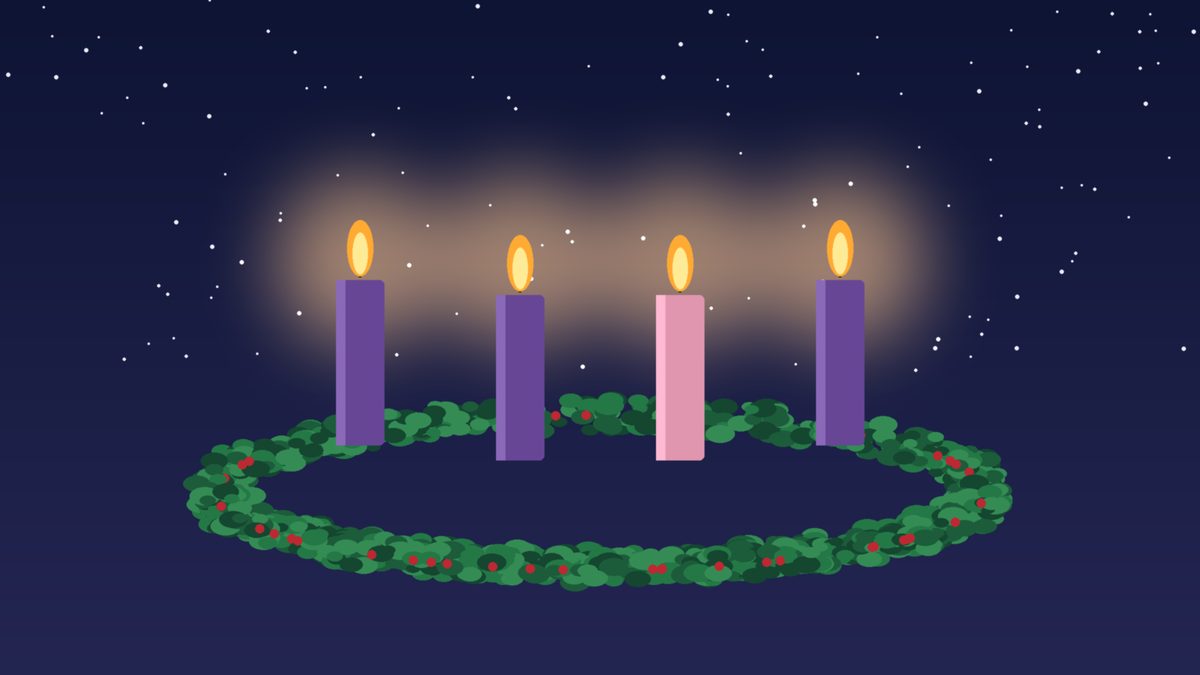
The wreath is a circle of evergreens with four candles, one lit more each Sunday. Traditions differ on what each candle stands for, so do not worry if your church does it a little differently. A common pattern is:
- Week 1: Hope (sometimes the prophets)
- Week 2: Peace (sometimes Bethlehem)
- Week 3: Joy (sometimes the shepherds)
- Week 4: Love (sometimes the angels)
Three candles are usually violet or deep blue, the traditional Advent colour for preparation and repentance. The third candle is often rose, lit on Gaudete Sunday (December 13, 2026). *Gaudete* is Latin for "rejoice," from "Rejoice in the Lord always! Again I will say, Rejoice!" (Philippians 4:4, WEB). Some families add a white candle in the middle for Christmas Eve or Christmas Day. The circle of evergreens is a reminder of life that does not run out.
Is Advent in the Bible?
The word and the four-week season are not in Scripture. They grew up in the church over the early centuries, and the pattern of four Sundays before Christmas took shape in the Western church over the following centuries. But the themes are thoroughly biblical: waiting on God, watching, repentance, and joy that comes before everything is fixed. Paul's line fits the season well: "It is already time for you to awake out of sleep, for salvation is now nearer to us than when we first believed" (Romans 13:11, WEB).
If your church does not observe the church calendar, that is fine. Advent is a help, not a command. Many Baptist, Pentecostal and non-denominational Christians use it simply as a way to prepare their hearts. If the whole idea feels unfamiliar, The Spiritual Practice of Waiting: What Advent Teaches All Year is a gentler place to start.
Simple ways to keep Advent at home
You do not need candles for each room or a long reading plan. Keep it small enough that you will actually do it.
1. Light one candle at dinner. Read a short passage (Isaiah 9, Luke 1, Matthew 1), say one prayer, blow it out. Three minutes is plenty. 2. Slow one thing down. Pick one rush to resist: shopping online at midnight, filling every weekend. Replace it with something unhurried. Hospitality Is Not About Your House. It's About Your Heart has ideas for inviting someone in instead of adding more to your calendar. 3. Use an Advent calendar that points somewhere. The first paper Advent calendars came from German Protestant homes in the 19th century, counting down to Christmas. A calendar with one Bible verse or one small act of kindness per day is worth more than a chocolate every morning, though a bit of both is fine. 4. Give something away. Advent is a natural time to practice what you say you believe about money. Generosity Changes You More Than It Changes Anyone Else is a good companion. 5. Pray when it feels flat. If this season carries grief, a first Christmas without someone, or silence in prayer, Advent is made for that. See When Prayer Feels Like Talking to the Ceiling. 6. Bring the kids in. Let a child light the candle and say what we are waiting for. Raising Kids With Faith in a World That Pushes Back has more on making it normal, not forced.
A short video that walks through the wreath, candles and calendar is What Is Advent? Meaning of the Advent Wreath, Candles and Calendar by Divine Vani - Prayers for All on YouTube, if you prefer to watch it explained.
Advent vs Christmas: should you wait to celebrate?
Many Christians keep Advent as a quieter lead-up and save the carols, big meals and parties for the twelve days of Christmas that begin on December 25. That is why some churches sing Advent hymns until Christmas Eve. But it is not either-or. You can put up the tree and still light the wreath. The point is not to ban joy. It is to remember what the joy is about.
If you are unsure about how much of the wider Christmas season suits your convictions, the same approach used for other seasonal questions applies: ask what it is doing to your faith and your family. Should Christians Celebrate Halloween? Start With All Saints' Day walks through that kind of thinking for the autumn holidays.
Frequently asked questions
When does Advent start in 2026?
Sunday, November 29, 2026. It ends on Christmas Eve, Thursday, December 24.
How many days is Advent in 2026?
26 days, counting from November 29 through December 24. The number of days changes each year, from 22 to 28, depending on which day Christmas falls.
What colour is Advent?
Violet or deep purple is traditional, with a rose candle or vestments on the third Sunday (December 13, 2026). Some churches now use blue to distinguish Advent from Lent.
Do all Christians celebrate Advent?
No. Catholic, Orthodox (in their own form), Anglican, Lutheran, Methodist and Presbyterian churches generally do. Many independent churches do not, though a lot of individual believers use it privately. It is not required in the Bible.
Is it a sin not to keep Advent?
No. It is a church tradition, not a commandment. Keep it if it helps you prepare for Christmas with attention and prayer.
Sources
- U.S. Conference of Catholic Bishops, 2026 Liturgical Calendar (First Sunday of Advent, November 29, 2026; Year B)
- Advent, Wikipedia (dates, wreath colours, Gaudete Sunday, Nativity Fast)
- What Is Advent? Meaning of the Advent Wreath, Candles and Calendar | Christian Season Explained, Divine Vani - Prayers for All (YouTube)
- Scripture quotations are from the World English Bible (public domain): Isaiah 9:2, 9:6; Mark 13:33; Romans 13:11; Philippians 4:4; Revelation 22:20.